Manufacturing Enters Simulation-First Era as OpenUSD Bridges Digital and Physical Worlds
High-fidelity simulation and OpenUSD standard bring 99% accuracy to manufacturing, slashing costs and cycle times dramatically.
Breaking: Simulation Now Production-Ready, AI Models Trained on Synthetic Data Achieve 99% Accuracy
High-fidelity simulation has crossed a critical threshold: synthetic training data is now accurate enough to train production-grade AI for live factory environments.
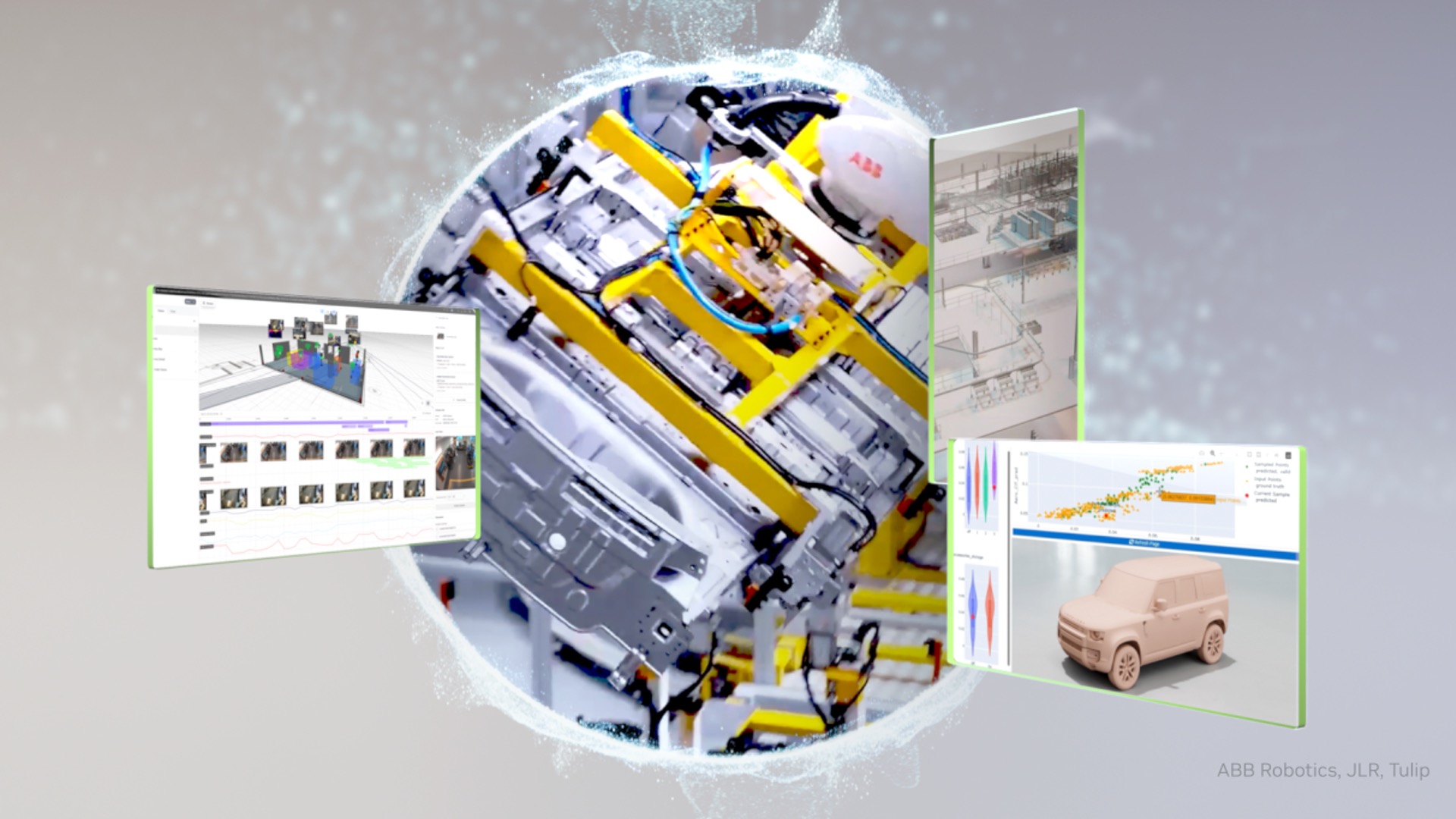
This breakthrough, driven by the OpenUSD standard and NVIDIA's Omniverse platform, is allowing perception systems, reasoning models, and agentic workflows to operate reliably on real assembly lines without extensive physical prototyping.
Manufacturers that have adopted the technology are reporting dramatic reductions in costs and cycle times, with ABB Robotics achieving 99% accuracy when transferring robot programs from simulation to physical deployment.
Background: The End of 'Build, Then Test'
Manufacturing's traditional design-build-test cycle rested on a single assumption: real-world testing was the only reliable environment. That assumption is now obsolete.
Previous attempts at digital twins failed because 3D assets lost physics properties, geometry, and metadata when moving between computer-aided design (CAD) tools and simulation platforms. Engineers had to rebuild assets from scratch for each pipeline.
SimReady, a content standard built on OpenUSD, solves this by defining what physically accurate 3D assets must contain to work reliably across rendering, simulation, and AI training pipelines. Combined with NVIDIA Omniverse libraries, it provides a physics-accurate, photorealistic simulation layer where AI models are trained and validated before deployment.
ABB Robotics: Closing the Sim-to-Real Gap
ABB Robotics integrated NVIDIA Omniverse libraries directly into RobotStudio HyperReality, its simulation platform used by over 60,000 engineers worldwide. The platform represents robot stations as USD files running the same firmware as their physical counterparts.
This allows engineers to train robots, test part tolerances, and validate AI models before a production line exists. Synthetic training variations—such as lighting conditions and geometry differences—can be generated at scale, covering scenarios impractical to replicate manually.
“We've managed to vertically integrate the complete technology stack and optimize it to a point where we're now achieving 99% accuracy on the simulated version,” said Craig McDonnell, Managing Director of Business Line Industries at ABB Robotics.
The results: up to 50% reduction in product introduction cycles, up to 80% reduction in commissioning time, and a 30–40% reduction in total equipment lifecycle cost.
JLR Accelerates Aerodynamic Simulation from Hours to Minutes
Jaguar Land Rover (JLR) applied the same simulation-first principle to vehicle aerodynamics. Engineers trained neural surrogate models on more than 20,000 wind-tunnel-correlated CFD simulations across the vehicle portfolio. Now, 95% of aero-thermal workloads run on NVIDIA GPUs, compressing what once took four hours of aerodynamic simulation into just one minute.
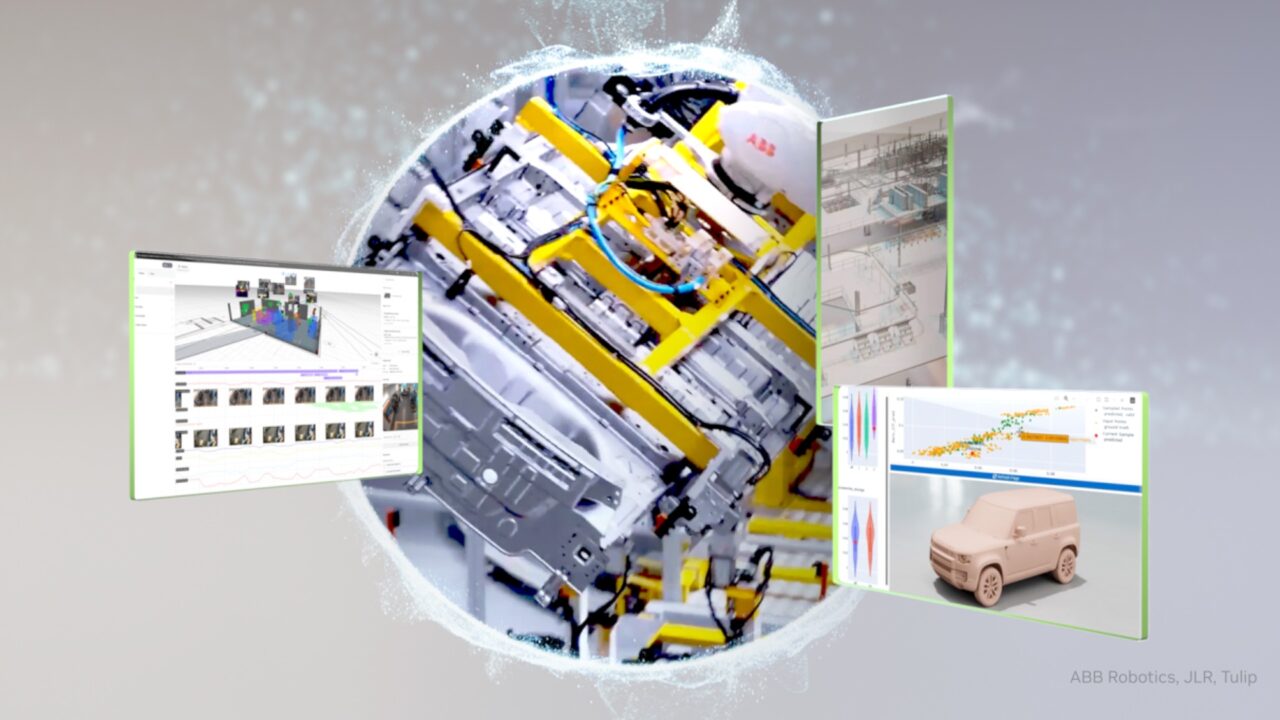
This allows JLR to explore many more design iterations virtually, dramatically shortening development timelines and reducing physical wind tunnel usage.
What This Means
The simulation-first era isn't a future concept—it's happening now. Manufacturers that adopt OpenUSD and simulation-first workflows will gain significant competitive advantages in speed, cost, and quality.
As physical AI becomes integral to industrial operations, the ability to train and validate AI models in a high-fidelity digital environment before touching a physical production line will become a baseline requirement.
Key takeaways:
- Simulation accuracy now exceeds 99% for sim-to-real transfer, as demonstrated by ABB Robotics.
- OpenUSD and SimReady eliminate the asset portability problem, enabling seamless data flow across the entire manufacturing pipeline.
- Dramatic cost and time savings: Up to 80% reduction in commissioning time and 50% faster product introductions.
- Scalable synthetic data generation covers edge cases that would be impractical to capture in the real world.
For manufacturers, the message is clear: Those who move to a simulation-first approach now will define the next decade of industrial productivity.
Industry Experts Weigh In
“This is the biggest shift in manufacturing since the adoption of computer-aided design,” said Dr. Elena Torres, a senior analyst at Industrial AI Research Group. “The ability to validate AI models with 99% accuracy in simulation before deployment removes the biggest barrier to automation.”
“OpenUSD is becoming the universal language for industrial digital twins,” added Mark Chen, Vice President of Manufacturing at Gartner. “Manufacturers who standardize on it now will have a significant integration advantage over competitors.”
As the technology matures, expect to see simulation-first workflows become the norm across automotive, electronics, logistics, and heavy equipment manufacturing.